


Please note, this article contains some spoilers for Resident Evil Requiem.
As the longstanding face of survival horror, the Resident Evil franchise has had to constantly reinvent itself in order to remain relevant in a rapidly growing industry. 30 years ago, it was about fixed camera exploration, resource conservation and an overall feeling of helplessness.
By 2005, however, the gaming landscape had changed, and so too did the tone of Resident Evil. With Resident Evil 4, only the most basic elements of aesthetics and monster design carried over, as the gameplay had been dramatically overhauled. Now, we were the ones in charge as we mowed down hordes of foes, with the action taking place from a dynamic over-the-shoulder perspective.
This was a great success, of course, but one that ultimately left the series’ origins behind. In the intervening years, we have watched a fluctuation between the concepts of horror and action with each entry. Resident Evil 7: Biohazard took things to a first-person angle, and in casting us as the overwhelmed everyman Ethan Winters, reignited those old feelings of dread.
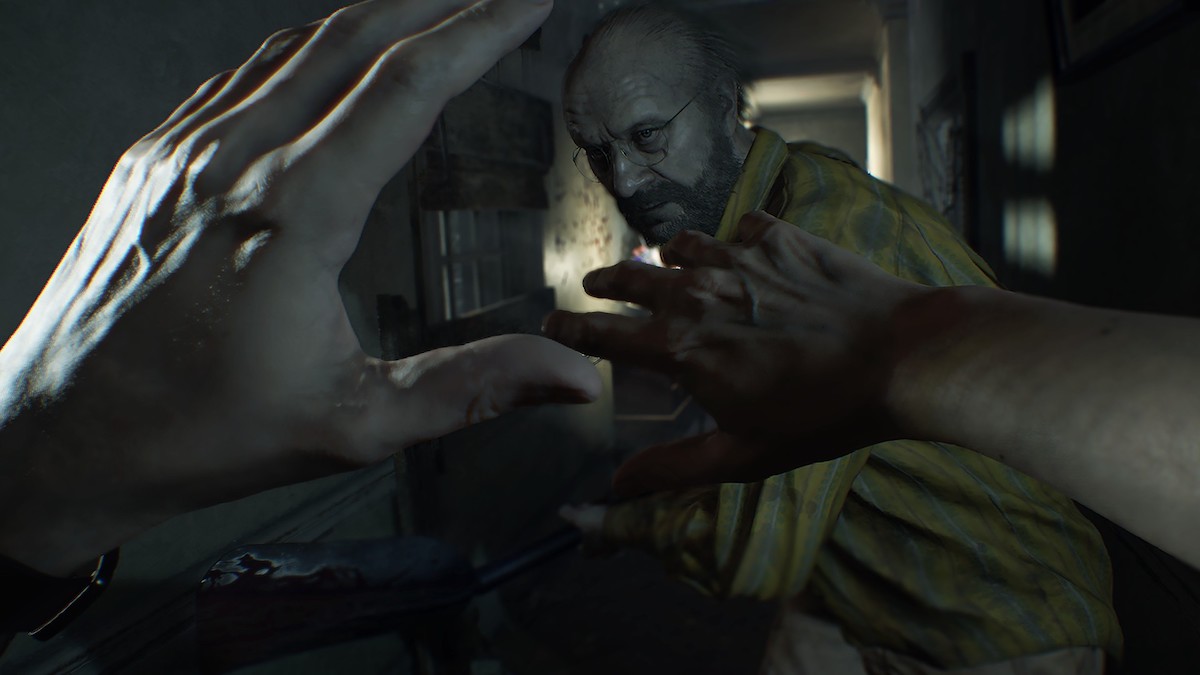
How you preferred your Resident Evil largely came down to personal taste, and for a while, you could reliably expect new entries to emphasise horror, whereas the remakes would tend to be more flashy and bombastic. It worked quite well, and with 2021’s Resident Evil Village, subsequent DLC allowed us to play the game through the third person perspective.
That was up until Resident Evil Requiem, the latest chapter in survival horror, and a game that capably juggles both. Between series newcomer Grace Ashcroft and the legendary hero Leon Kennedy, you practically have two completely different experiences crammed into one enormous package.
Grace’s sections, which defaults to a first-person angle unless you choose otherwise, are the familiar games of cat-and-mouse that the Ethan Winters duology made famous. You can take down enemies with your firearms if you so choose, however this comes with significant risk: not only are bullets scarce, but every shot you take can alert nearby zombies.
And worse still, if you insist on rampaging around the place like a petite blonde Rambo, those corpses have a chance of respawning as ultra dangerous Blister Heads — a masterstroke taken straight from the pages of 2002’s Resident Evil and its Crimson Heads.

Once you’re in Mr. Kennedy’s shoes, things take a wild turn in every sense of the word. Recommended to be played in third person, Leon is a master of combat who can cycle through a myriad of guns before following things up with a flying kick to the face. Equipped with a powerful hatchet he can use to separate heads from shoulders, it’s everything you’ve come to expect from the pithy R.P.D. veteran.
What makes Requiem compelling in this aspect, is that the jarring change of pace doesn’t feel out of place for the most part. As Grace, your first big challenge is making your way through the Rhodes Hill Care Centre. The various rooms are just crawling with baddies, and in my first playthough I felt quite overwhelmed. They were everywhere, dammit, and they were more than capable of killing me in an instant.
Afterwards, Leon arrives on the scene and sets about murdering everything in sight. It’s so gratifying to exact revenge against those pesky zombies that had hounded you so; like summoning your big brother to settle the score against a schoolyard bully.
The back and forth continues in this fashion up until around the halfway point. After a particularly tense and dramatic scenario where Grace is finally able to dispose of the hideous giant that had been stalking her throughout the game, Leon returns to Raccoon City to seek out the truth behind the dreaded Elpis virus.

This turns out to be one of the longer sections of the game, introducing a point system for felled foes that can then be exchanged for artillery and upgrades, and it’s not necessarily for everyone. Prior to this, Grace’s levels were the more involved sections, with Leon acting as more of a palette cleanser who didn’t overstay his welcome.
Raccoon City is a sprawling area with a wealth of buildings to explore, and considering its gritty atmosphere, it more closely resembles The Last of Us than anything we had been experiencing up to this point. For me personally, it was my least favourite part of the game, and a number of reviewers clearly felt the same.
On behalf of IGN Italy, Alessandra Borgonovo expressed that, “the first half with Grace offers a tense, atmospheric survival horror experience that hints at a bright future for the franchise. However, the second half completely betrays that promise, descending into a chaotic mess of forced nostalgia, nonsensical retcons, and a disrespectful treatment of its new characters.” (This quote was translated from the original Italian, obviously.)
Personally, I didn’t feel quite as slighted, and I believe Alessandra’s 70 score for Requiem to be overly punitive. But her viewpoint isn’t necessarily too far off my own.
I don’t think Raccoon City is bad, per se, it’s just disparate from the gameplay package as a whole, and throws off the established sense of pacing. Even the final section afterwards doesn’t quite hit the heights of Rhodes Hill, as Grace is now equipped with enough tools to capably handle the threats lurking about — though there is something to be said for the wonderfully stressful flashback to the Raccoon City Orphanage, a short segment that surpasses even Resident Evil 2’s game of hide and seek.

Regardless of how you feel about the game’s pacing, the enduring question on my mind is whether or not Capcom have put themselves in a corner with the interwoven campaigns of Leon and Grace. This isn’t necessarily a new concept, and jumping between characters has been present since the PS1 trilogy.
It’s never been this heavily involved, however, with Sherry and Ada’s gameplay sections from RE2 making up only a tiny portion of gameplay. Later games such as the Revelations titles upped the ante with constant back-and-forth, only to functionally play largely the same regardless of who you were piloting at the moment. Chris and Parker were bulkier versions of Jill, and Keith would have been better off not existing at all.
But now, we’ve got something that works. A Grace archetype — a terrified civilian up against impossible odds — paired up with a Leon archetype — a one-man army who is powerful, skilled and confident. Requiem is a content heavy game, partly as a result of this direction, and straying from this path could be viewed as a downgrade from here on.
I can just hear the clacking tongues, chiding that, “oh, the new Resident Evil is all spooky hallways and jump scares? No thanks, I’d rather be roundhouse kicking monsters in the face,” or, “oh, the new Resident Evil is just another overstuffed shoot-em-up? That’s how we ended up in the gutter of Resident Evil 6, you may recall.”

Short of taking on a completely unforeseen new gameplay style, I honestly don’t know where they go from here except forward on this same path. Thankfully, smarter people than me are the ones actually in control of the franchise, and my lack of ideas could simply stem from an overall lack of vision. Anyone who read my 2024 piece spectating on possible directions for Resident Evil 9 could tell you, I was way off the mark in almost every regard.
I won’t make that mistake twice (aside from hoping that RE10 will tie up Village’s BSAA cliffhanger at last), but I will at least give credit where credit’s due: Resident Evil Requiem stakes a worthy claim as one of the best entries that this franchise has ever seen. As far as celebrations for the 30th anniversary go, you could scarcely do better than this.
Shameless plug: You can watch my entire Resident Evil Requiem playthrough on YouTube if you’d like. Or maybe even if you wouldn’t like, I’d appreciate the clicks.

Leave a Reply